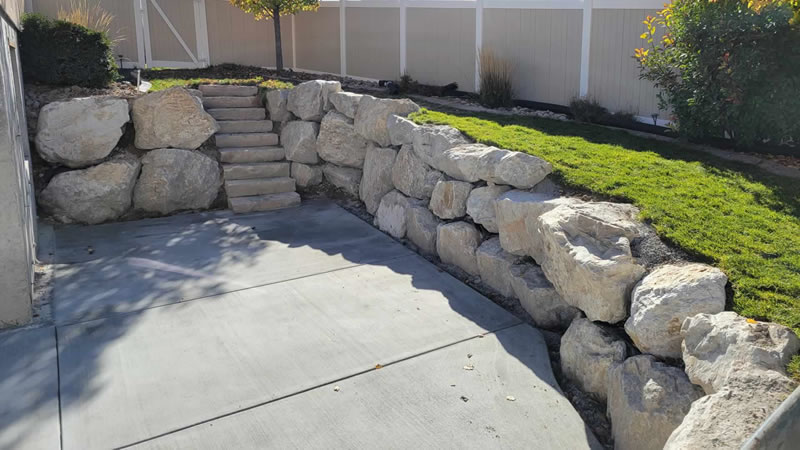
Some landscaping solutions look like they were built. A boulder wall looks like it was always there.
That's the defining quality of a well-installed boulder wall — it has a presence and permanence that manufactured materials simply can't replicate. Large natural boulders, carefully selected and expertly placed, create a wall that feels like a natural extension of the Michigan landscape rather than something dropped into it.
For Oakland County homeowners dealing with sloped yards, erosion problems, grade changes, or a property that simply needs more structure and definition, a boulder wall is one of the most visually impactful and long-lasting solutions available. And in many cases, it's also more cost-effective than comparable manufactured block walls.
This guide covers everything Oakland County homeowners need to know about boulder walls — how they work, what they cost, how they compare to other wall options, and what it takes to build one that holds up through decades of Michigan winters.
A boulder wall is a retaining wall or landscape feature built from large natural stones — typically weighing anywhere from 500 to 3,000 pounds or more per boulder — that are set and stacked using heavy equipment to create a stable, gravity-based structure.
Unlike manufactured block retaining walls, which rely on interlocking precision-cut units and sometimes geogrid reinforcement, boulder walls use the sheer mass and natural shape of the stones to hold back soil, resist lateral pressure, and define slopes. The weight of the boulders is what does the work — each stone sits firmly against the next, creating a wall that becomes more stable over time as it settles into the landscape.
Boulder walls are used across Oakland County for a wide range of applications:
Boulder walls bring a rugged, organic character to any landscape that manufactured products simply cannot reproduce. Each boulder is unique — different in shape, color, texture, and size — and that variation is exactly what gives boulder walls their authenticity. They look like they belong in Michigan's natural environment because they are natural Michigan materials.
For properties with wooded lots, natural grades, or a naturalistic landscape style, boulder walls are the perfect complement. They blend into the environment rather than standing out against it. In communities across Oakland County — from the wooded estates of Bloomfield Hills and West Bloomfield to larger lot properties in Clarkston and Lake Orion — boulder walls consistently deliver the kind of landscape character that homeowners are looking for.
Boulder walls are among the most long-lasting hardscape features you can install on your property. When properly built, a boulder wall can last 50 to 200 years — far exceeding the lifespan of timber walls, and competitive with or exceeding manufactured block in many real-world applications.
Natural boulders are inherently resistant to erosion, weathering, and freeze-thaw damage. They don't crack, fade, chip, or deteriorate the way manufactured materials can over time. The same freeze-thaw cycle that challenges other materials has been shaping and hardening these stones for thousands of years — they're already built for Michigan winters.
One of the most important structural advantages of boulder walls is that the gaps between natural stones allow water to drain freely through and away from the wall without building up hydrostatic pressure behind it. Water pressure is the leading cause of retaining wall failure — and boulder walls address this naturally, without requiring the same level of engineered drainage systems that manufactured block walls depend on.
That said, professional boulder wall installation in Oakland County still includes proper base preparation and drainage planning — especially given the area's heavy clay soil and significant frost depth. The natural drainage characteristics of boulder walls are an advantage, not a replacement for proper installation.
This surprises many homeowners, but boulder walls are frequently less expensive per square foot than comparable manufactured block retaining walls in Michigan. The reason is efficiency — boulder walls are built using heavy equipment like skid loaders and mini excavators that can move and place large stones quickly. Manufactured block walls require significantly more manual labor — setting a perfectly level base course, stacking individual blocks precisely, and capping the top.
The result is that boulder walls often deliver more visual impact per dollar than block alternatives — especially on larger wall projects where the equipment efficiency is most pronounced.
Once a boulder wall is properly installed, it requires virtually no ongoing maintenance. There's nothing to reseal, repaint, or replace. The natural stone doesn't fade or deteriorate. Occasional inspection to ensure the wall is performing as expected is essentially all that's required. Over a 20 or 30-year period, the total cost of ownership of a boulder wall is among the lowest of any retaining wall option available.
Boulder wall costs in Michigan typically range from $25 to $55 per square foot installed, depending on boulder type and size, wall height and length, site accessibility, and drainage requirements.
Here's a practical cost breakdown for Oakland County homeowners:
Small boulder wall (under 2 feet tall, 20–40 linear feet): $3,000–$8,000A simple garden-level boulder border or low retaining wall. Ideal for defining planting beds, edging lawn areas, or creating a low terrace on a gently sloped lot.
Mid-size boulder retaining wall (2–4 feet tall, 40–80 linear feet): $8,000–$18,000The most common residential boulder wall application in Oakland County. Holds back a meaningful grade change, creates usable flat space on a sloped yard, or defines a major landscape zone.
Large or tiered boulder wall system (4+ feet, multiple tiers, 80+ linear feet): $18,000–$40,000+For significant grade changes, hillside stabilization, or properties that require a full terracing system. These projects require heavy equipment access and careful engineering to ensure long-term performance.
Factors that affect boulder wall cost in Oakland County:
This is one of the most common questions Oakland County homeowners ask when planning a retaining wall project. Here's an honest comparison:
Boulder walls deliver a natural, organic look that feels like it belongs in the Michigan landscape. Ideal for naturalistic, wooded, or rustic landscape styles.
Block walls offer a clean, uniform appearance with consistent color and texture. Better suited for contemporary or formal landscape designs where precise lines and a polished finish are priorities.
Boulder walls are typically at or below manufactured block on a per-square-foot basis in Michigan, particularly on larger projects where equipment efficiency is most significant.
Block walls involve more manual labor per square foot, which can make them more expensive — especially on longer, taller walls. Premium block product lines can push costs significantly higher.
Both are extremely durable when properly installed. Boulder walls have the edge on raw longevity — natural stone that has survived millions of years of geological pressure is not going to fail in an Oakland County winter.
Block walls can develop issues if the base fails, drainage is inadequate, or if lower-quality block products are used. Premium block systems from manufacturers like Techo-Bloc are engineered for Michigan's climate and perform very well.
Boulder walls require heavy equipment — skid loaders, mini excavators, and sometimes cranes for very large stones. Equipment access to your site is an important factor.
Block walls are primarily manual labor intensive and can be installed in tighter or less accessible spaces where heavy equipment can't reach.
Boulder walls — virtually zero ongoing maintenance once properly installed.
Block walls — minimal maintenance, but cap stones may need occasional re-gluing and sealing is recommended on some product lines.
The bottom line: If you want a natural look, have a large wall project, value maximum longevity, and have reasonable equipment access to your property — a boulder wall is very likely the right choice. If you have tight equipment access, prefer a more formal or contemporary aesthetic, or need a more precisely engineered wall on a challenging site — block may be the better fit. At Driftwood Landscape, we help Oakland County homeowners work through exactly this decision based on their specific site and goals.
Understanding how a boulder wall is properly built helps you recognize quality work and ask the right questions of any contractor.
A professional boulder wall contractor walks the site, evaluates the grade, soil conditions, drainage patterns, and equipment access. The size, height, and configuration of the wall are planned before any equipment arrives.
The ground is excavated to the proper depth — in Oakland County, this means getting below the frost line to prevent frost heave from destabilizing the base. A compacted gravel base is established to provide a stable, level foundation for the first course of boulders.
Perforated drainage pipe and clean gravel are positioned behind the wall's base to manage water movement away from the structure. Even though boulder walls drain naturally through their joints, a proper drainage system behind the wall is essential in Oakland County's clay soil environment.
This is where the artistry comes in. Using a skid loader, mini excavator, or crane, boulders are carefully selected, positioned, and set with a slight backward lean — called batter — into the hillside. This lean is critical: it means the wall leans into the soil it's retaining, using gravity to its advantage.
Each boulder is individually evaluated for face, rotation, and fit. The right placement of each stone determines both the structural integrity of the wall and its visual character. This is not work that can be rushed — the skill of the installer directly determines how the finished boulder wall looks and performs.
Clean gravel backfill is placed and compacted behind the wall as it rises. The surrounding grade is finished to direct water flow away from the structure and blend the installation naturally into the landscape.
The completed boulder wall is inspected to confirm proper batter, drainage flow, and overall appearance. The site is cleaned and any disturbed areas are graded and seeded as needed.
1. Make sure equipment access is realistic before getting a quote. Boulder walls require heavy machinery. Before planning a boulder wall project, think through how equipment will access your backyard — gate width, overhead clearance, proximity to structures. Your contractor will assess this during the consultation, but thinking about it in advance helps avoid surprises.
2. Don't underestimate boulder selection. The character of your boulder wall is determined largely by the quality and character of the stones themselves. A contractor who takes care in selecting boulders with good face, color variation, and appropriate size will produce a wall that looks far superior to one built from whatever was cheapest or most available.
3. Plan drainage as part of the project from day one. Even though boulder walls drain naturally, proper drainage planning behind the wall is essential in Oakland County's clay soil environment. This should be included in the project scope from the beginning.
4. Consider tiered designs for steep slopes. A single tall boulder wall can work, but for properties with significant grade changes, a series of tiered boulder walls — each holding back a smaller amount of soil — often looks more natural, performs better long-term, and creates usable terraced areas between the tiers.
5. Pair your boulder wall with plantings for the best finished look. Boulder walls and natural plantings are a natural pairing. Adding native grasses, groundcovers, ferns, or flowering perennials between and around the boulders softens the installation, further blends it into the landscape, and helps stabilize the soil behind and above the wall.
Do boulder walls require permits in Oakland County?In most Oakland County municipalities, retaining walls under 3 feet in height do not require permits. Walls over 3–4 feet typically require a building permit, and walls over 5 feet may require engineered drawings. Permit requirements vary by specific city or township. A reputable contractor will know the requirements for your municipality and handle the permitting process.
How long does a boulder wall installation take?Most residential boulder wall projects in Oakland County take between one and five days depending on wall length, height, and site complexity. Larger or more complex multi-tier systems may take one to two weeks.
Can a boulder wall be built on any slope?Boulder walls can handle a wide range of slope conditions, from gentle grade changes to steep hillsides. Very steep slopes may require engineering review and a tiered approach. Your contractor will assess the site conditions during the consultation and recommend the appropriate design.
Will a boulder wall shift or settle over time?Some minor settling is normal with any wall during the first year or two as the structure and surrounding soil reach equilibrium. This is more noticeable with boulder walls than with mortared stone because boulders sit on a compacted base without adhesive. A properly installed boulder wall with good base preparation and drainage will settle minimally and remain stable for decades.
Can boulders be sourced locally in Michigan?Yes — Michigan has access to various natural stone types suitable for boulder walls, and locally sourced boulders reduce transportation costs significantly. Your contractor will source appropriate boulders based on your project's size, aesthetic goals, and budget.
Building a great boulder wall requires more than heavy equipment and a pile of rocks. It requires an experienced eye, careful stone selection, proper base preparation, and the skill to place each boulder so the finished wall is both structurally sound and visually compelling.
At Driftwood Landscape LLC, boulder walls are one of our signature services across Oakland County. We've built boulder walls on sloped properties throughout the area — from low garden borders to large multi-tier hillside systems — and every one is built with the same attention to drainage, base preparation, and craftsmanship that makes the difference between a wall that lasts a generation and one that shifts and fails in a few winters.
If your Oakland County property has a slope, an erosion problem, or simply needs the kind of natural structure and definition that only a boulder wall can provide — we're ready to take a look.

A professionally installed boulder wall is one of the most impactful, long-lasting investments you can make in your property. The team at Driftwood Landscape is ready to assess your site, discuss your goals, and show you exactly what's possible.